
Powder Coating

In powder coating, the pigment and binder are a very fine powder. The powder is sprayed onto a metal part that is one pole of a high voltage charge. The powder gun, which uses both compressed air to spray the powder and electricity to provide the static charge, applies the powder over the object. The static charge causes the powder to adhere to the object, just like dust adheres to a TV screen. The powder is only just barely clinging to the object, and may be easily removed. If you drop the object on its way to the oven, the powder falls off and will need to be re-applied.
Once the object is coated, it is placed into an oven and fired at 400-450 degrees F for 15-20 minutes or so after the coating has melted. During this time, the powder melts and "cures," undergoing some kind of chemical reaction in which some toxic fumes are released. The resulting surface is very tough and smooth, almost like a ceramic glaze.
Until recently, powder coating was something that needed to be done by specialty shops, because it involved expensive equipment and large walk-in vented ovens. However, if you are just going to do small parts, Harbor Freight sells a unit for $100 (Note - It goes on sale for $60 once in a while!) and a can of the powder for $10.
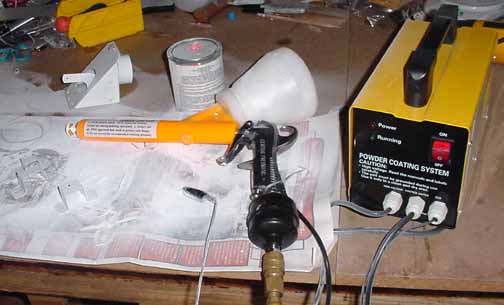
Above, the power unit is on the right - there is also a foot pedal on the floor (not shown) used to switch the high voltage on or off. The gun's trigger starts the compressed air to spray, and it has white gloss powder from the can at the rear loaded in its jar. Although the electrostatic charge helps to keep the powder on the object, there is still a good amount of overspray. The stuff that HF sells is "Weather Resistant Polyester" and a little goes a long way. Just like in liquid paints, there are Polyester, Urethane, Epoxy and Hybrid varieties of binders to choose from. The can advises not to exceed a coating of .004 inch thickness to avoid drips - I have no idea how to measure that easily, but after a practice try, you get a feel for it. To the left of the gun is a clip used to ground the object. At the upper left is a cabin heat box I coated. The powder is extremely fine, and the label warns about contact, so use a respirator when applying it. The resulting coat is a bit thicker than a spray from a rattle can - make sure you mask off threads, etc.
Also, since the fumes from the stuff while curing are also toxic, you really shouldn't be using the family oven for it, but I got a fairly large toaster oven that will bake to 450 degrees at Walmart for $40. I use it in the garage only with the doors open. Total investment to get started - $100.
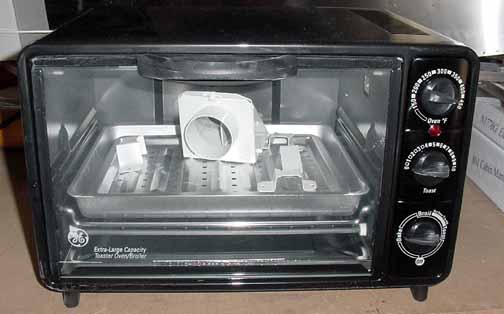
Above, some firewall mounting hardware pieces and the cabin heat box are cooking. Once it gets to temperature in the oven, the coating is just like any wet paint, so it can run and drip, but unless you get the powder on really thick, it doesn't run very much. Also, the first piece I tried I didn't get all of it covered very well (it's definitely a good idea to practice on something first) so I applied another coat and fired it a second time. Worked great.
One note - since the temperature is rather high, you shouldn't do any structural parts that might loose their temper, like 6061-T6. Any steel or any aluminum that does not have stressed loads on them should be fine.
Another note - I have read on some lists that powder coating can obscure cracks, so structural things like engine mounts shouldn't be powder coated. After looking into the types of pigment and resins, I don't see any difference really. If you put a polyester resin powder on the same thickness as a polyester paint is applied, you end up pretty much with the same thing, except the powder coat is baked on. In other words, It is just as easy to cover up cracks with a primer and spray that is too thick as it is to cover one up with a powder coat. Dissenting opinions are welcome.
Images on this website are either Copyright Zenith Aircraft Company and used by permission or are copyright Gary Liming